Why do they call us “HAM”? From the legends of Harvard to the first Bulgarian HAM

Why are we called
Why are we called “HAM”? From the legends of Harvard to the first Bulgarian HAM

Why are we called “HAM”? From the legends of Harvard to the first Bulgarian HAM

Have you ever wondered why radio amateurs are called “HAM” (which means “ham” in English)? It sounds a bit funny, doesn’t it? After all, what does a smoked ham have to do with antennas and transceivers?

In this adventure, we will find out how an insult became an honorary title and how Bulgarians “broke” the airwaves long before the internet was even an idea.

Legends: Three Students and a Congress

One of the most entertaining (albeit slightly embellished) stories takes us back to 1908 at Harvard University. It is said that three students – Hyman, Almy and Murray – founded one of the first amateur radio stations. They simply called it HAM (from their initials).

The story goes that when the US government decided to get its hands on the airwaves in 1911, young Hyman gave such a passionate speech to Congress that politicians were moved and left frequencies for amateurs. Since then, the whole world has started calling operators “HAMs.” A nice story, isn’t it? Almost like Hollywood!

The Truth: Ham Hands and “Filthy” Airwaves

If you ask serious historians, however, the version is a little more prosaic and… biting. At the beginning of the 20th century, professional telegraph operators were real “aristocrats” of the airwaves. They called any novice operator who transmitted Morse code clumsily and with errors, “ham-fisted” (with hands like hams – fat and clumsy).

When radio amateurs started building transmitters in their basements and “interfering” with serious military stations, the professionals angrily shouted: “Those hams are jamming our signals again!”. Instead of getting angry, the radio amateurs said to themselves: “Hey, that sounds cool!” and proudly adopted the name.

The Bulgarian Trail: The True Pioneers of LZ

While the rest of the world was called “hams,” in our country history is written with great enthusiasm and little available materials. Here’s how it all happened:

  • The Beginning (1926): It all started in the Sofia City Casino, where 38 daredevils founded the first “Bulgarian Radio Club.” Their goal? To unite all those interested in the “invisible waves”.
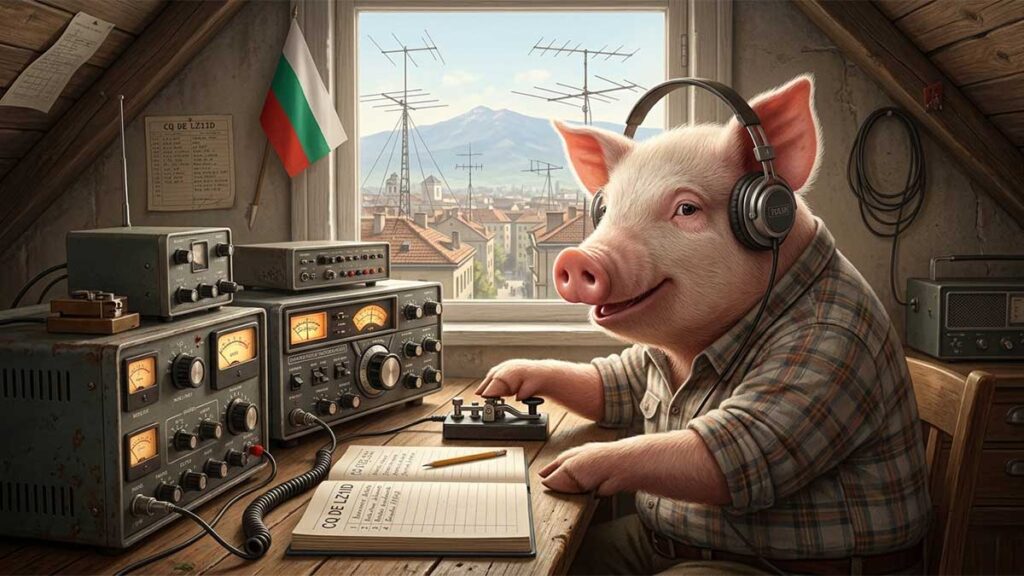
  • The First Call (1938): The legendary Ivan Djakov constructed a transmitter in Sofia and on April 24, 1938, sent the first amateur radio call from Bulgaria: “CQ de LZ1ID”. Djakov became so popular abroad that he was a “desired prey” for every amateur radio operator in the world! In 1945, Ivan Dzhakov resumed his amateur radio activity from Sofia with the initials LZ1XX, and later LZ1RF.
  • The first club station (1949): At the very peak of Christmas (December 25) in 1949, LZ1AA began operating with operator Ognyan Kukurov.
  • LZ1KAB and the era of DOSO (1952): The Central Radio Club was opened on Slaveykov Square. The first official connection was on 7 MHz, again by Ognyan Kukurov. From then on, Bulgarian radio amateurs became some of the best in the world in “fox hunting” and high-speed telegraphy.
Why are we HAMs today?

Whether the name comes from “clumsy hands” or from three students, today being a HAM means being part of a global network. We are the people who stay connected when everything else stops. We are the ones who organized the first radio connections between computers, when the Internet had not yet entered our daily lives, including to the military contingent in Cambodia (Anton Ivanov – LZ3AI here and Vasil Vassilev – LZ3WW there). We are the experimenters who reflect signals from the Moon and talk to Antarctica (with initials LZ0A, thanks to Miko Mikov – LZ1RR and Yordan Yankov – LZ1UU).

So, if you hear “HAM”, don’t think of a sandwich. Think of 100 years of innovation and friendship on the air!

73 and a follow-up on the air!

Tony, LZ3AI


Bibliography and sources
  1. Danev, P. (LZ1US), Radio amateurism in Bulgaria. History, facts, memories, Sofia, 1998.
  2. Boyadzhiev, S., Macedonia in my life. Memories, Sofia, 2013.
  3. Wikipedia, History of Amateur Radio in Bulgaria (free encyclopedia).
  4. Radio Magazine (archives), organ of the Bulgarian Radio and Television Association/National Radio and Television Association.
  5. ARRL (American Radio Relay League), Etymology of the term ‘HAM’.
LZ2KAL – self-made radio club in the village of Alekovo

LZ2KAL – amateur radio club village of Alekovo

Someone once /before 1960/ created an amateur club in the village and put into operation an amateur radio station with the initials LZ2KAL. This probably happened with the help of the district radio club in Veliko Tarnovo. According to the memories of Kiril Iliev LZ2JA, in 1968/69 he was a radio training instructor – he helped move the old LZ2KSQ transmitter and a concert receiver to the school in the village of Alekovo in order to revive the activities of LZ2KAL. The initiative probably failed for unknown reasons.

LZ2KAB – radio club at a youth center

LZ2KAB – radio club at the youth center

The organization of the radio club at the youth center in the village of Polikraishte was the work of Rumen Sarnov LZ2DD, who also became the head of the radio station, and Stefan Getsov LZ2PS – who led the educational activities for the preparation of children from the primary grades of the local school. The radio club has two premises – one is a small radio hall with 10 workstations, and the other is equipped with a radio station. The material part was donated by the V. Tarnovo district radio club. Initially, the transmitter was an old factory Czech “KUF” for CW operation, and later they purchased a UW3DI-I transceiver and a final stage of a GU74. Good radio operators were prepared from the Morse code classes held. Of these, Iliyan Kushev LZ4AR and Ivan Angelov LZ2IAA remain in the amateur radio hobby.

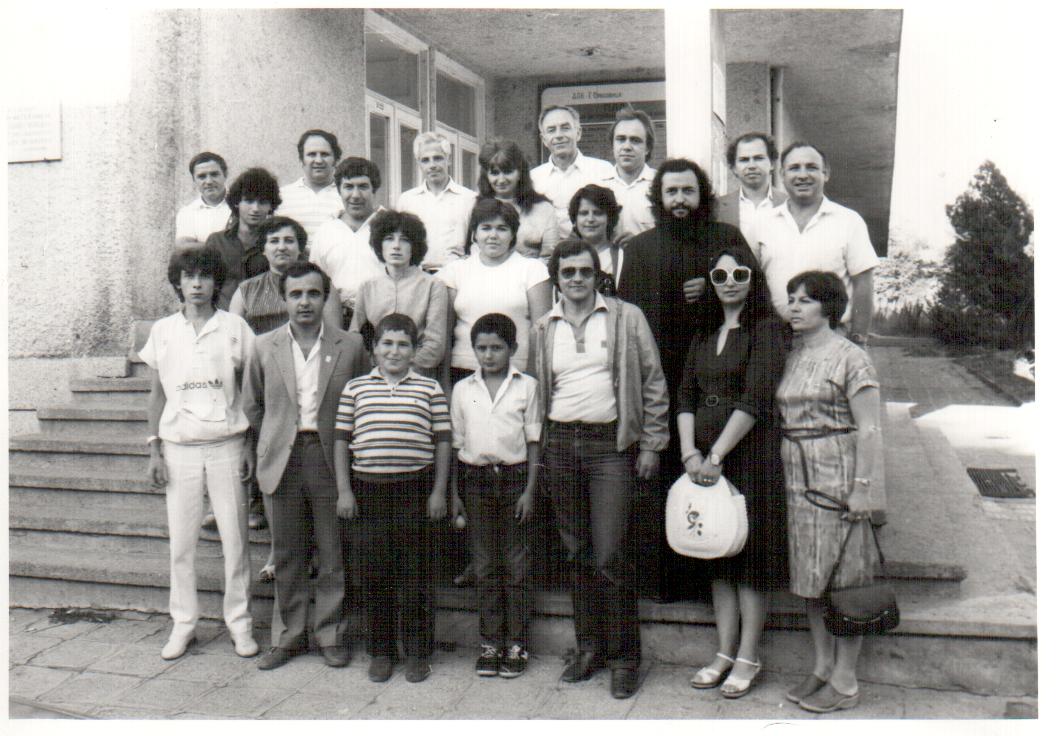
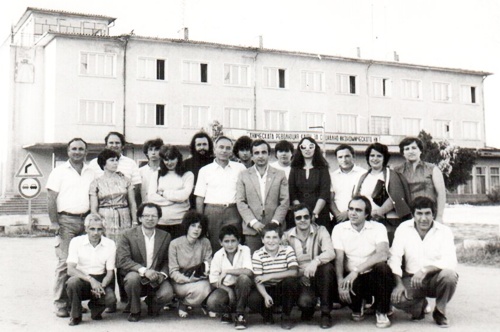
LZ2CWW
LZ2CWW


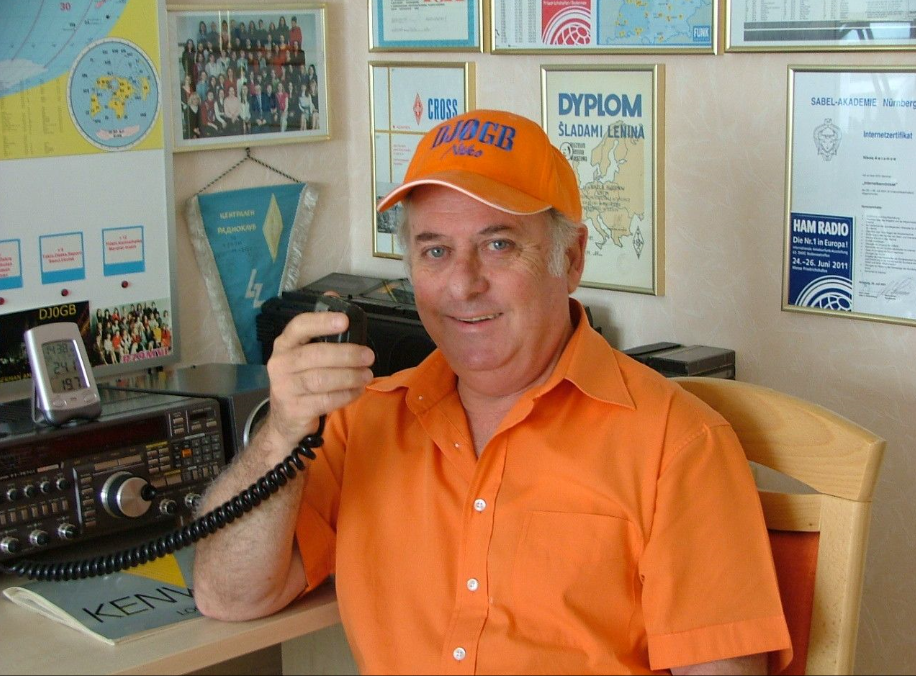
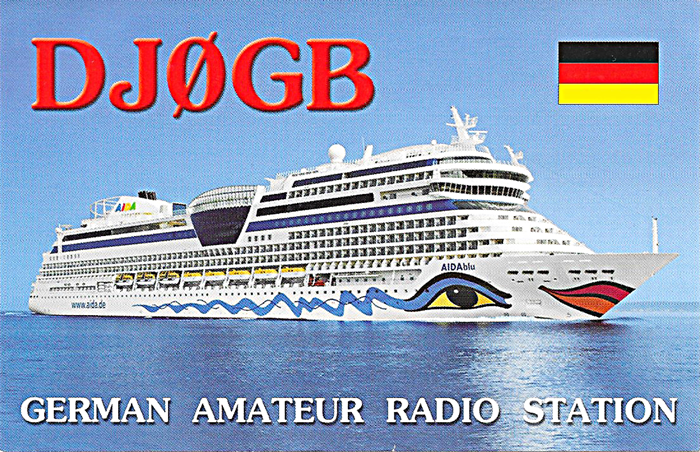
NIKO AVRAMOV – DJ0GB (ex. LZ2DJ)

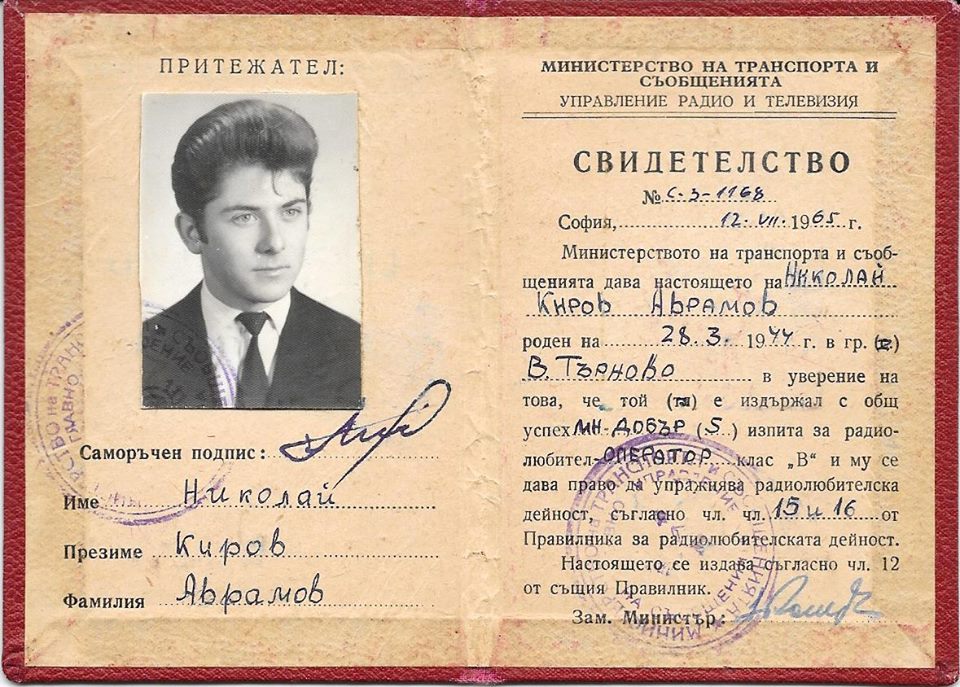
I started with amateur radio very early. In 1958, I enrolled in a course at the pioneer home in Tarnovo to study radiotelegraphy. During our training, we had the opportunity to visit the pioneer radio station LZ2KBS and see how shortwave radio connections are established. This interested me a lot, even though at that time they only worked on telegraphy. The radio station had a low power of 25 watts and at that time radio connections could only be made within Bulgaria. From then on, I decided to continue my hobby with amateur radio and later enrolled in the radio club in Tarnovo. At that time, the head was Kiril Nestorov (by Kircho). There I continued to practice and later passed the exam for amateur radio class “C”. From then on, I was already allowed to work at the radio station LZ2KAC, where I went every day to make radio connections. I have also sat up all night, together with other members, to make radio contacts and participate in competitions. At that time, due to our great interest, the radio station worked almost continuously and we made a very large number of radio contacts. In 1965, I passed the exam for a radio amateur class “B” and in 1972, class “A”.

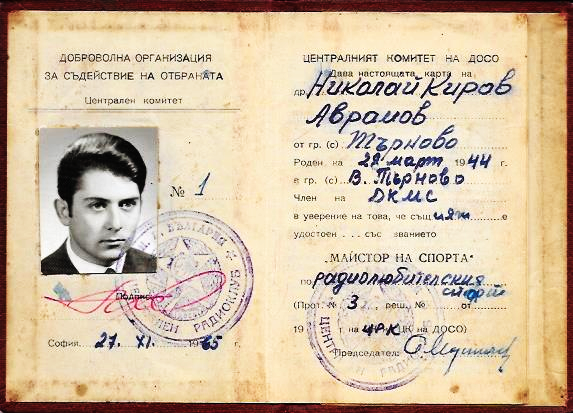
In the same year, 1965, I participated together with two other radio amateurs, Nik Pisarov (LZ2JF) and Angel Lichev (LZ2UG), in a republican championship for establishing radio contacts by radiotelegraphy. At this championship we won first place in Bulgaria with LZ2KBA and according to the competition regulations, the three of us received the title of “MASTER OF RADIO AMATEUR SPORT”.

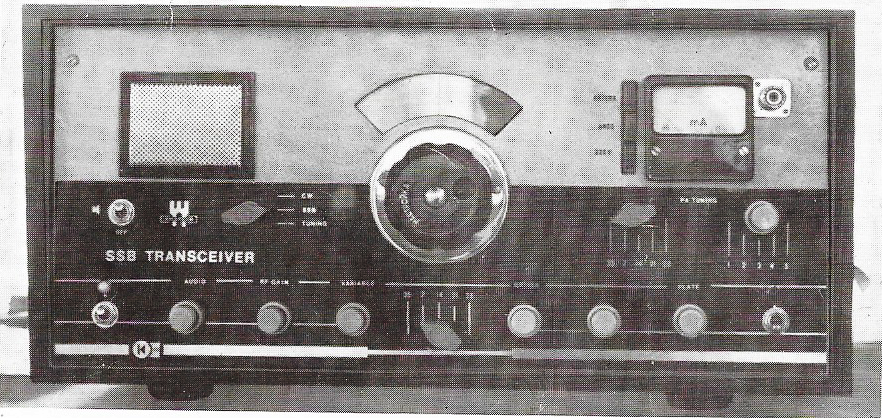
After completing my high school education in 1962, like everyone else at the time, I had to go to the barracks. I was assigned to the city of Kardzhali in a communications platoon. From the very beginning, the platoon commander, after checking me as a radio operator, assigned me the task of training young and old soldiers in radio telegraphy, in addition, I had to start working at the radio station and maintain radio contact with the division in Haskovo. After I returned from the barracks in 1964, I started working at the radio factory in Veliko Tarnovo and it was completely clear to me that radio engineering would be my profession in life. A year later, I enrolled to study radio engineering at the V. Lomonosov Technical School in G. Oryahovitsa. After completing my radio engineering education in 1968, I was entrusted with training future workers for the radio factory in Veliko Tarnovo in the radio club. In the meantime, I received a permit to build a radio station and in 1971 I started building a transceiver in my spare time at the radio club, which lasted until 1972. At this point I must say that I was given a small financial assistance from the radio club for the construction of my transceiver. At the same time I married a German citizen and had to leave to live permanently in Germany (at that time it was the GDR). In the summer of 1972 my transceiver was exhibited at TNTM in Plovdiv where it was awarded and I received a Soviet watch and a diploma as a prize. This was the third transceiver made in Bulgaria. The first transceiver in Bulgaria was made at that time by Kiril Drundarov (LZ2ZK) also from the radio club in Veliko Tarnovo. The second transceiver was made at the same time in Kazanlak by Nikolay S. Pasturmov (LZ1YI) and was also presented at TNTM.

This is a photo of my transceiver from that time.

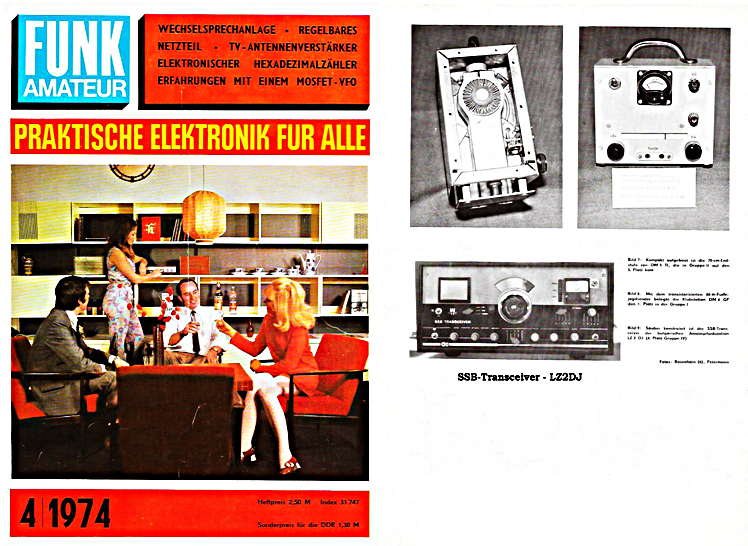
In 1972, we built a small house in the “Kartala” area to “move” the radio station during competitions. Later, I left in early December with my transceiver for the GDR and after great difficulties and detention at the border for Romania, which is why I arrived one day late in Leipzig, much to the disappointment and worries of my wife in Germany. Later I received in the GDR, then my first German initial DM9BJM, and after the official change of all initials I received the second initial Y29JM with which I worked until 1988 from Leipzig. In 1973 I presented my transceiver at the radio amateur meeting of all radio amateurs from the GDR in Leipzig and then my transceiver was awarded a diploma for the second time and printed in the German magazine Funkamateur 1974.

This is Funkamateur magazine 4/1974 front and back page-original where my transceiver was published at the time.

In Germany, this transceiver was ranked fourth out of all German exhibits, for me it was a big award. Of course I also received a German diploma (GDR) which unfortunately I no longer have. In the summer of 1988, I moved with my whole family to West Germany – Bavaria, and my transceiver had to stay in Leipzig. A move out of the GDR was absolutely impossible. And so I parted with my transceiver, which I had been building for almost a year in Veliko Tarnovo. After we settled in Nuremberg later, I received a new initial DJ0GB, which I still use today. All this was very difficult at that time, given the political conditions at that time. In the GDR I worked as an electrical engineer at the Karl Marx University in Leipzig and later as a tour guide-translator in Russian with Soviet groups who came to the GDR on excursions. This job was very interesting and I worked there for exactly 10 years until “perestroika” came, and then I started working in the computer industry as a maintenance technician for a computing station in a company in Leipzig until 1988.

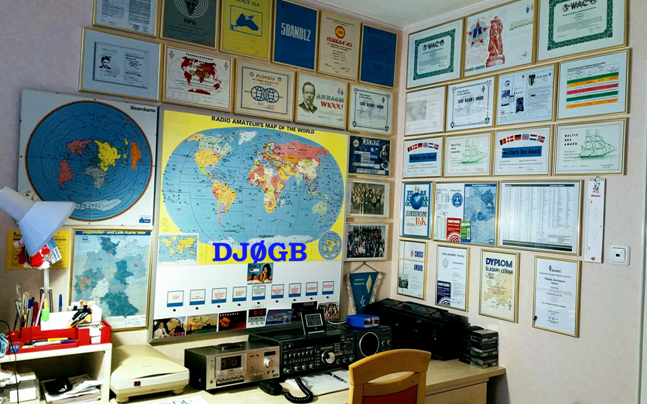
Here is a photo of my shack with all my 22 diplomas in Nuremberg
I am currently working with a YAESU FT-767GX transceiver (100 watts.) Antenna FB4-41m


Some examples of amateur radio shirts with your own initials. They are made in the USA to order and delivered to your home. address

My Facebook-site is https://www.facebook.com/NikoAwramow

LZ2KSQ – amateur club in the town of Svishtov

Amateur club in the town of Svishtov

There is no information or anyone’s memories about the initial organization of an amateur club in the town of Svishtov. This probably happened before 1960, and initially a transmitter made in the Tarnovo radio club + a concert receiver was used, which in 1968 were moved to the school in the village of Alekovo to revive the activity of LZ2KAL. Shortly before that, a 3-story transmitter with GU50 was built for LZ2KSQ and a communication receiver was obtained. The educational activity – training of primary school students was handled by Todor Kolev (sk) – a teacher by profession. The work of the radio station was handled by Todor Kolchev LZ2TK (sk) – a professional radio operator in the Bulgarian Radio and Television Service, who used a semi-automatic mechanical key “vibroplex”.

Stefan Nenkov - the head of the amateur radio club after 1970.
Stefan Nenkov – the head of the amateur radio club after 1970.

In early 1970, the public radio club in the town of Svishtov was established as a full-time club. The year was used to recruit personnel – people engaged in and willing to engage in amateur radio activities, equipping a hall and a cabinet for design activities, a radio station and materials. In the fall of 1970, the first school year was opened. Groups were trained in radiotelegraphy, radio construction and training of conscripts-communications officers. Subsequently, over the years, the volume of students increased many times. The radio station with the call sign LZ2KSQ conducted the first communications since the opening of the club. In 1970-72, two radio transmitters were built – 50 and 250w and one transceiver for SSB. The same participated in a TNTM review and won 2nd place. In 1974, a communications center was built, from where HF and VHF competitions were held. In the same year, the first VHF communications were also conducted by reflection from meteor trails and via amateur radio satellites. In 1975, amateur clubs were opened in the village of Tsarevets LZ2KCT and in the village of Gorna Studena. Groups are being trained in radiotelegraphy, radio construction, and work is underway to train radio station operators. The leaders are Dimitar Blazhev and Iliya Zhelev, respectively.

Angel Gugov LZ1CY, Iliya Kirilov LZ1IKY and Stefan Nenkov

SPORTS
In the first years of the club’s establishment, teams were formed in high-speed radiotelegraphy, radio all-around, and radio detection. It participates in district and republican competitions every year. The student team in high-speed radiotelegraphy and radio all-around is a two-time republican champion. The pioneer teams in radiotelegraphy are multiple district champions. Leader Todor Kolev (sk).

CONSTRUCTION ACTIVITY

During its existence as a state club, this activity developed at a serious pace.

  • 1970 – HF transmitter 50w – Nikola Stoyanov
  • 1971 – HF transmitter 250w – Stefan Hristov
  • 1972 – HF transceiver SSB – Stefan Hristov
  • 1973 – HF transceiver SSB – Bozhidar Atanasov
  • 1974 – VHF transmitter + converter – Stefan Hristov
  • 1975 – HF transceiver SSB – Petar Angelov /LZ4PA/
  • 1975 – HF transmitter – Dimitar Blazhev
  • 1976 – VHF antennas 4x 10 elements /45 m above the ground/
  • VHF amplifier 250 watts
  • HF antenna double square + antennas for low ranges
  • HF transmitter – Zdravko Petkov /LZ2BZ/
  • HF transceiver SSB – Nikola Stoyanov
  • VHF converter 432 MHz
  • 1978 – Amateur television SSTV – Petar Angelov /LZ4PA/
  • 1 KW HF amplifier – Krasimir Lazarov /LZ4SU/
  • Mounted 5m diameter parabolic antenna /432/ with tracking system
  • 1979 – VHF radio station 144/432 MHz – Stefan Hristov – 1st prize in the rep. review of TNTM
  • 1982 – HF transceiver SSB – Petar Angelov – 1st prize in the rep. TNTM review
  • VHF antenna 16×32 elements /432/ for EME
  • 1984 – 1 KW VHF amplifier for 432 MHz for EME QSO

During the period 1977 – 2000, various measuring and auxiliary equipment were made, which helped the overall activity of the club. After the launch of the VHF repeaters, many VHF transceivers were built and modified – Krasimir Kunev, Petar Sashev, Kiril Stefanov, Atanas Slavev.

Peter Angelov LZ4PA and Iliya Kirilov LZ1IKY. Participating in a VHF competition at the base.
Petar Angelov LZ4PA and Iliya Kirilov LZ1IKY. They are participating in a VHF competition at the base.
Ilya Kirilov LZ2IKY works on UW3DI
LZ2KSQ op Krasimir Lazarov-now LZ4SU

HF AND VHF ACTIVITY

Undoubtedly, in this activity the club has achieved the greatest success. It must pay tribute to Iliya Kirilov /LZ1IKY/, Ivan Pavlov, to the students Zlatko, Lyubcho, Stefan, to Petar Angelov, Krasimir Lazarov and many others.

Iliya Kirilov - now LZ1IKY
Iliya Kirilov – now LZ1IKY
  • The VHF radio station is a leader in its participation in Republican competitions. VHF Marathon – Dimitar Blazhev.
  • The first EME connection on 432 MHz in 1984 was a great success = LZ2KSQ-DL9KR. Subsequently YU, F, G, SM, PA.
  • The title of “Master of Sports” was awarded to 7 club activists.
  • 2 club radio stations and 9 personal ones were opened and operated.
  • From participation in Republican and International competitions, TNTM reviews, National radio design exhibitions, the Municipal Radio Club of Svishtov has won 134 gold, silver and bronze medals. 22 diplomas and international plaques.

Stefan Hristov was the head of the Svishtov radio club at that time.

made by LZ4PA - excellent designer and builder
made by LZ4PA – excellent designer and builder

Personal radio stations in Svishtov:

LZ2AKW Krasimir Vassilev Kiselov

LZ2DS Atanas Ivanov Slavev

LZ2SSB Petar Sashev Petrov

LZ2TK (sk) Todor Kolev

LZ2BZ Zdravko Todorov Petkov

LZ4PA Petar Nikolov Angelov

LZ4SU Krasimir Lazarov Lazarov (sk)

LZ2AGA Andrey Georgiev Andreev

LZ2KKP – amateur city radio club Polski Trambesh

LZ2KKP – amateur city radio club Polski Trambesh

There is no information about the time of the club’s establishment (1956? ) and its members. The only thing is that one of the transmitters was built by Gergi Zahariev Karailiev LZ2GZ (sk). A small RX Cushcraft was used as a receiver. The radio station was located in a large building at the station. Memories from Mikhail Borisov Trifonov LZ1MBT /ex LZ2MB/, who in the summer of 1967 was on an internship installing the ATC equipment at the new PTT station in the city, and made almost daily CW radio contacts from LZ2KKP.

Georgi Zahariev LZ2GZ(sk) is a talented self-taught radio technician. He was the first to put SSTV into operation.

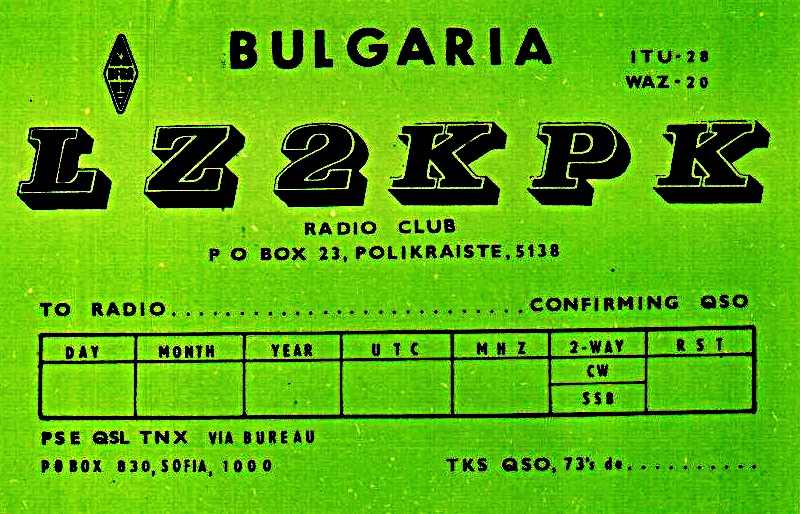
LZ2KPK – Amateur Radio Club, Village of Polikraishte

LZ2KPK – Amateur Radio Club Village of Polikraishte

On 10.10.1966, several people, enthusiastic young people, set the beginning of an organized amateur radio movement in the village of Polikraishte.

In a room, in a private house, on the village square – Boncho Vassilev /LZ2AS-sk/, Boyan Adzharov (sk) – activist of the radio club in G. Oryahovitsa and Milko Pendov /LZ2UC/, placed on a table /taken from the community center/ a converted concert receiver “Orpheus”, a Morse code manipulator and a buzzer and “the wheel turns”. It starts with listening activities and a radiotelegraphy circle with students from local elementary schools /3/. During this time, the transmitter of the future radio station was built with 100% materials provided by the District Radio Club LZ2KBA with head Ivan Popov /LZ2SA/ and on a cold winter day, on 15.01.1968 LZ2KPK went on the air with about 50 watts on a GU50 and Ant VS1AA.

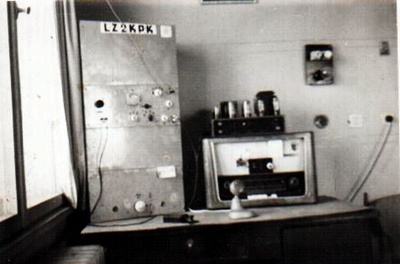
The first transmitter and the receiver "Orpheus"
The first transmitter and receiver “Orpheus”

The receiver is the same “Orpheus”, but it was later replaced with the Russian KV-M and then with the Bulgarian “Signal”.

As a result of the positive impact among the youth, the amateur radio club received the support of the mayor’s office, the school administration, the public in the village and the most effective was the financial assistance from the local APC/TKZS/.

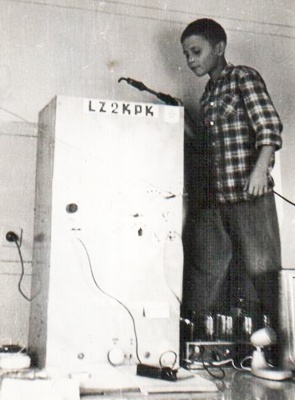
"Something is wrong with the coil..." the youngest operator at 13 years old Rumen Sarnov / now LZ2DD/
“Something is wrong with the coil…” the youngest operator at 13 years old Rumen Sarnov / now LZ2DD/

Thanks to this assistance, a 10m steel pole was erected on the building of the Agricultural Complex where the radio station is located, on which a 4-element antenna was built cubic square for 14/21 MHz with a boom length of 9m. For 3.5 MHz a Delta was made, materials were prepared for the manufacture of 3 elements of a beam for 7 MHz and 5 elements of a square of 28 – but unfortunately the latter were not realized.

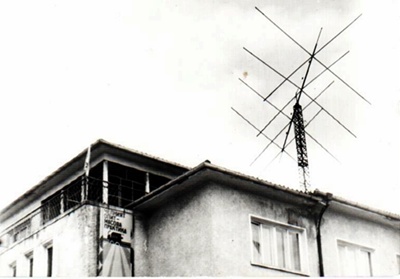
LZ2KPK - 4 ele quad 14/21 MHz
LZ2KPK – 4 ele quad 14/21 MHz

The educational activity continues at a good pace – every year there are three circles – two in telegraphy – for beginners and for advanced and one in radio detection “fox hunting”. The latter is going poorly due to problems with the material base – an insufficient number of receivers and only one transmitter.

It only reaches participation in district competitions. The number of operators is constantly changing, but there are periods when their number reaches 15-20 and this leads to the organization and opening of a second radio club in the village at the Youth Center with the initials LZ2KAB.


Radio amateur operators regularly take part in internal republican and international HF competitions with varying success, but there are also prize places. In the 90s of the last century, the activity of the clubs gradually died out and after 2000 they officially ceased to exist, but they remain the most ardent on the air. One statistic: as of 2010 in Polikraishte there were 9 personal amateur radio stations with 22 initials for about 2000 inhabitants.

On the occasion of the club’s 20th anniversary in 1986, Polikraishte hosted the IV National Meeting of Amateur Radio Families.

Initials in Polikraishte:
LZ2KPK, LZ2KAB – Ceased to exist 2000 – officially.
LZ2AS (sk), LZ4WJ
LZ2UC, LZ2CU, LZ4UC,
LZ2PS, LZ4UU, LZ2YVV, LZ2CWW
LZ2UR, LZ2OR, LZ2HW, LZ2HU
LZ2DD, LZ2IAA, LZ4ZZ, LZ4AR
LZ2DB (sk), LZ2TB, LZ4BW, LZ4BD, LZ2UAA
LZ2CRA

Radio clubs – a place for patriotic education of youth

Reporting and election conference of the radio clubs in the Veliko Tarnovo district in 1972.

On March 11 of this year, the reporting and election conference of the radio clubs from the district was held in Veliko Tarnovo. Representatives of the District and City Committees of the Komsomol and many radio amateurs were present.

In his report, the secretary of the district radio club, Ivan Popov, took stock of the clubs’ activities during the reporting period, emphasizing their increased activity in the military-patriotic education of youth.

Currently, 650 young men and women are being trained in the various training units of the radio clubs, with over 200 of them regularly participating in district and city competitions. The quality of the training work is being improved, the material base is being enriched, and the qualifications of the leaders of the training groups, coaches and judges are being raised. Over the past year, the number of young radio designers has increased significantly, which is due not only to their natural interest in this discipline, but also to the good material base of the radio clubs.

To improve the educational work among the pioneers, a pioneer camp-school in radio training was organized last year, in which 53 pioneers from different settlements of the district participated. During the camp, they conducted classes in radiotelegraphy, radio design, radio detection and radio communications. The first pioneer camp of its kind in the country unequivocally showed that the path to training and promoting the educational forms is effective and correct.

During the reporting period, the highest successes were achieved in the competitive activities of the operator team of the district radio club, which ranked 1st in the republican VHF championship, and m. s. Ivan Popov, m. s. Nikolay Pisarov and c. m. s. Dimitar Raykov were included in the list of the best athletes in the country for 1970.

The Veliko Tarnovo designers performed excellently at the III and IV TNTM review in Plovdiv. Ivan Popov and Kiril Drundarov received gold badges and a diploma for their transceivers, and the design team was ranked 1st for the SSB radio station they developed. The activity of the design section does not stop there. As a result of systematic and persistent work, a 3.5 MHz radio detection transmitter with automatic control was developed and constructed; a 144 MHz receiver and transmitter for mass repetition by the district radio clubs, etc. are in the process of being developed.

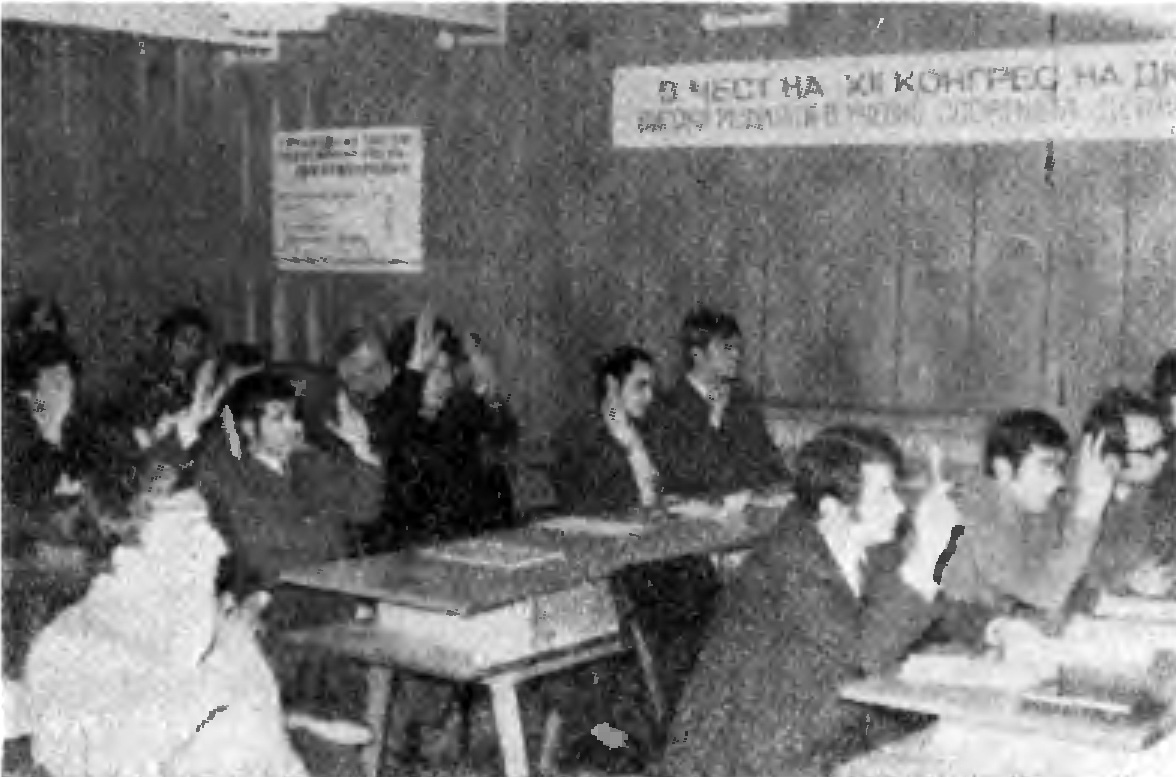
Along with these positive results, the conference noted a number of weaknesses and still unresolved problems in the activities of the radio clubs. The ideological and educational work is still poor in form and content; individual events and activities do not meet the requirements set by the XI Congress of the DCMS on the military-patriotic education of youth; radio disciplines are still not sufficiently promoted and do not always reach the Komsomol organizations and societies in schools and enterprises, which is why the organizational assistance that the Komsomol committees provide for the preparation of the school year in the radio clubs is also insufficient; there is a high turnover in the study groups, which hinders and degrades the quality of the study work; High sporting achievements are still rare in competitive sports, which speaks of unsatisfactory coaching work.

The amateur radio stations in the district also deserve attention. For the majority of young people, they are the attractive force that leads them to the radio club, connects them with its life and tasks. Unfortunately, some committees clearly underestimated this role of theirs. Over the past year, the radio stations in the district did not work actively, and some of them were almost in QRT. This led to schematic and “dry” classes in radiotelegraphy and reduced the interest of young people in this otherwise interesting discipline. And yet this is only one side of the issue. We cannot ignore the fact that many stations do not have the necessary number of QLS cards, modern equipment and good operators.

An important problem in the activities of radio clubs is also radio all-round competition, which practically unites almost all academic disciplines. It should not be forgotten that high-speed reception and transmission, the exchange of radiograms and movement in azimuth lie at the heart of the future military radio operator. Therefore, it is necessary to fully utilize the material base of the clubs and to seek the assistance of the local military units.

The educational work of the district radio club will be significantly improved after the construction of the new building and the sports complex for radio disciplines.

The conference adopted decisions on ideological and educational work, military-patriotic education, educational and sports-competitive activities and on improving propaganda and agitation. The participants in the conference elected by an absolute majority a new club council and delegates for the republican conference in Sofia.

Yordan M. Gaydarov

The Amateur Radio Village

The Amateur Radio Village

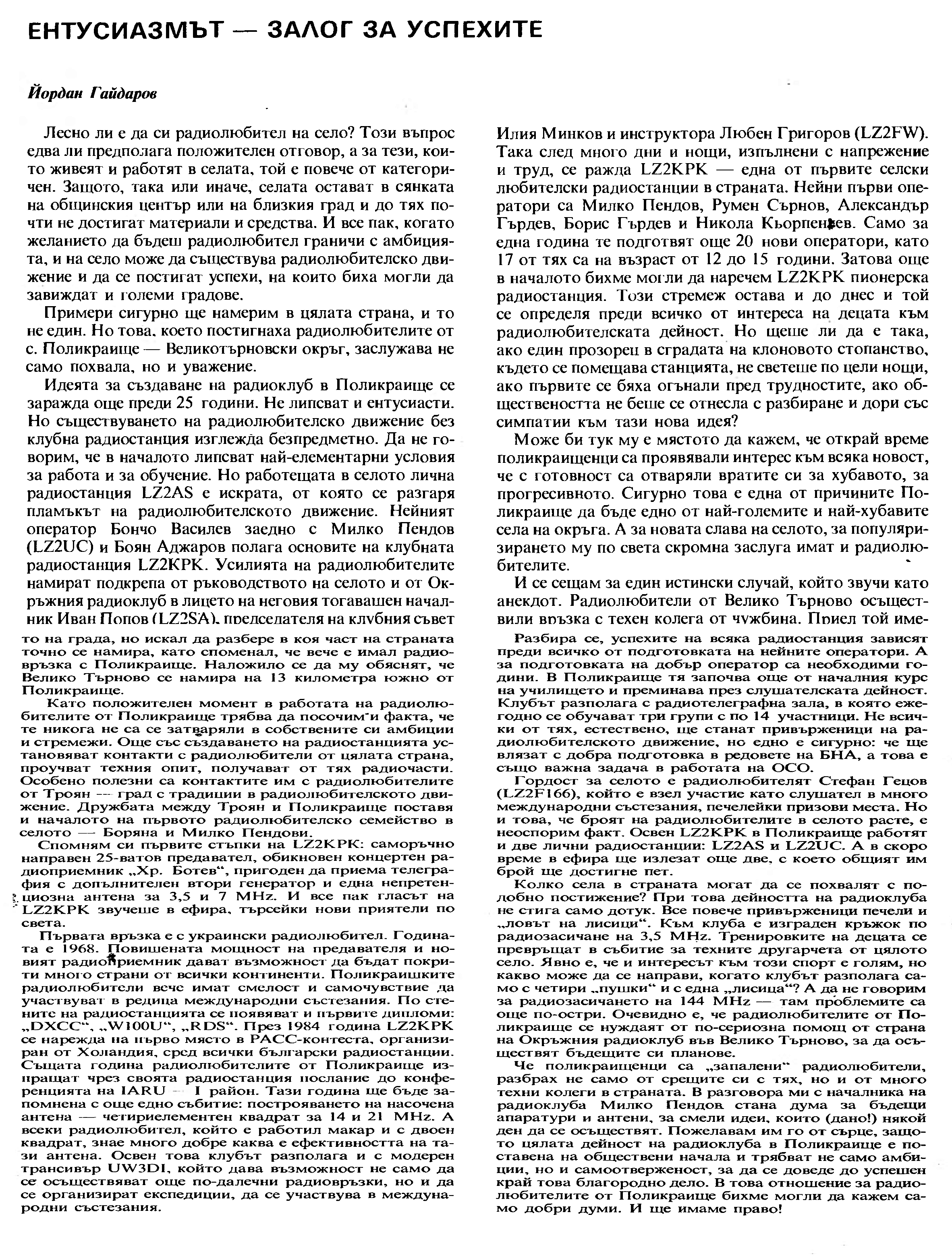
On 10.10.1966, several enthusiastic young people initiated an organized amateur radio movement in the village of Polikraishte.

In a room, in a private house, on the village square – Boncho Vassilev /LZ2AS-sk/,

Boyan Adzharov/SK/ – an activist of the radio club in G. Oryahovitsa and Milko Pendov /LZ2UC/, placed on a table /taken from the community center/ a converted concert receiver “Orpheus”, a Morse code manipulator and a buzzer and “the wheel turns”. It began with listening activities and a radiotelegraphy club with students from local elementary schools /3/. During this time, the transmitter of the future radio station was built with 100% materials provided by the District Radio Club LZ2KBA with head Ivan Popov/LZ2SA/ and on a cold winter day, on 15.01.1968 LZ2KPK went on the air with about 50 watts on one GU50 and Ant VS1AA.

The receiver was the same “Orpheus”, but was later replaced with the Russian KV-M and then with the Bulgarian “Signal”. As a result of the positive impact among the youth, the amateur radio club received the support of the mayor’s office, the school administrations, the public in the village and the most effective was the financial assistance from the local Agricultural and Rural Development Committee/TKZS/.

Thanks to this assistance, a 10m iron pole was erected on the building of the Agricultural and Rural Development Committee where the radio station is housed, on which a 4-element square antenna with a boom length of 9m was built. A Delta was made for 3.5 MHz, materials were prepared for making 3 elements of a beam for 7 MHz and 5 elements of a square of 28 – but unfortunately the latter were not implemented.

The educational activity continues at a good pace – every year there are three circles – two on telegraphy – for beginners and for advanced and one on radio detection “fox hunting”. The latter is going poorly due to problems with the material base – an insufficient number of receivers and only one transmitter.

It only reaches participation in district competitions. The number of operators is constantly changing, but there are periods when their number reaches 15-20 and this leads to the organization and opening of a second radio club in the village at the Youth Center with the initials LZ2KAB.

The radio amateur operators regularly take part in internal republican and international HF competitions with varying success, but there are also prize places. In the 90s of the last century, the activity of the clubs gradually died out and after 2000 they officially ceased to exist, but they remained the most active on the air. One statistic: as of 2010, in Polikraishte there were 9 personal amateur radio stations with 22 initials and about 2000 inhabitants.

On the occasion of the 20th anniversary of the club in 1986, Polikraishte hosted the 4th national meeting of amateur radio families.

Milko Pendov /LZ2UC/

LZ2KAD – city radio club – Gabrovo

LZ2KAD – city radio club – Gabrovo

Whoever and whenever starts talking about the radio club in Gabrovo, must start with the name of its creator – Eng. BORIS KONYAROV.

Memories of Lyuben Penkov (later LZ2LF) from Balchik, one of the veterans of our amateur radio movement.

He says: “I was born on August 5, 1916. I have been involved in amateur radio since my teenage years, when I was still a student at the Bulgarian high school in Dobrich. I still have my “Standard” headphones that I bought in 1935 for 250 lei. At that time, Southern Dobrudzha was Romanian. I read Romanian magazines and saw how far Romanian radio amateurs had come in this field. They had created their own organization, they made radio connections with radio amateurs from all over the world. In the fall of 1935, together with my friend Boris Konyarov, who was also my student, we decided that we should try it too. We constructed the first amateur transmitter in Southern Dobrudzha – a single-tube Hartley generator, but the first tests did not work because we were cutting the common minus, not the anode circuit”.

======================================================================================

Boncho Vassilev (later LZ2AS) from Polikraishte remembers: “My amateur radio activity began in 1948-1949. I was a student at the electrical engineering school in Gabrovo under the guidance of Eng. Konyarov, whom the radio amateurs in Gabrovo honor as the founder of the amateur radio movement in this city. One evening he turned on an ordinary receiver somewhere on short waves. Morse signals were heard, he recorded something and said: “A Romanian is working with a Frenchman”. This deeply impressed me and I became interested. I learned the Morse code.

Who is Eng. BORIS KONYAROV:

1927: People crowded the square in the town of Dobrich. The gaze is directed towards a roof where the “priests” of a new magic trick are stretching wires. Fragmentary, strange words are heard: Radio!…Budapest…Rome…Tokyo…Everyone is jostling.. A dry, thin boy with a neatly folded school cap makes his way through the crowd, not without difficulty. This is Boris Konyarov’s first encounter with the wonderful world of radio waves. Young Konyarov is very studious – he reads literally around the clock and even has his reading time limited on doctor’s advice. A few years after the radio session, Boris comes across the book “The Miracle of Radio Waves” by E. Eisberg.

And this encounter is fateful. The book contains a diagram of the black box /TELEFUNKEN receiver/, which the master of séances once showed. The book is in French – accessible and fascinating for Boris: “The world of radio waves is accessible to everyone.” Boris with youthful enthusiasm rushes into this new world, everything is now clear to him and the path to his first receiver is not long: here a capacitor, there a coil… There is no crystal, but… he will grate some lead, add sulfur powder, light the alcohol lamp and – the crystal is ready! The receiver is expensive, but the good grandmother will sacrifice a few more levs for the ambitious grandson.

The receiver is ready and he listens to broadcasts every day. My books and experience increase daily.

Years later, together with Yordan Boyanov, they try to find a place in the amateur radio field. But then this is impossible because “Radio broadcasts” are a state monopoly.

After the end of WW-II, Konyarov is already an engineer and works in Gabrovo. There, in 1946/47, he creates one of the first amateur radio clubs at the National Radio and Television Institute, and later at the Mechanical and Electrotechnical School. The number of radio amateurs is growing rapidly. Among the first are Botyu Botev /later senior research associate at the Bulgarian Academy of Sciences/, Ivan Mechev, Hristo Hinov, Shkodrev – designers at the DIP “Electronics” Gabrovo, Stefan Dunev – republican champion in “fox hunting” and many others.

In 1949-1950 the first radio club was built. It bears the name of A. S. Popov and is a source of pride for the people of Gabrovo. During this time in the country, at the National Radio and Television Union there were only sections and circles of this kind.
Will, enthusiasm, patriotic deeds – this is the basis of the activity of the club led by Konyarov. Exhibitions of the work of radio amateurs are organized, classes dedicated to radio amateurism on local radio equipment. In Gabrovo, a feverish radiofication begins, expansion and improvement of the existing radio equipment according to the project of Eng. Konyarov. The performers are enthusiasts from the radio club – dressed in foreman’s clothes, led by Konyarov, erect poles, stretch wires, install radio points.

Eng. Boris Konyarov, in addition to his activity in Gabrovo, is a member of the council of the Tarnovo district radio club and a member of the Republican section of radio amateurism at the Central Committee of the Bulgarian Radio Amateur Society. Later, he is a member of the council of the district radio club in Ruse. In Ruse, he is first the head of the OSS, and then the director of the printed circuit board factory.

The time of this man, who has dedicated himself, outside of his responsible official duties, to a wide range of public activities, is very precious. How much time does he dedicate to his listeners through lectures and talks, to rationalizers/as he himself is/, to young radio amateurs…

A tribute to the memory of this titan-creator of the radio amateur movement in our region.

About the Gabrovo Radio Club:

According to Rumen Stefanov LZ2RS:

The radio club was founded around 1946-48.

1. 1st NR unknown /or Konyarov…/.
2. Trifon Kolev- until 1962
3. Atanas Gatev – until 1968
4. Ivan Sofroniev until around 1970
5. Kolyo Kolev
6 Ivan Ivanov