What is a typical telephony radio connection (FM/SSB/AM QSO)?
First steps on the air of telephony
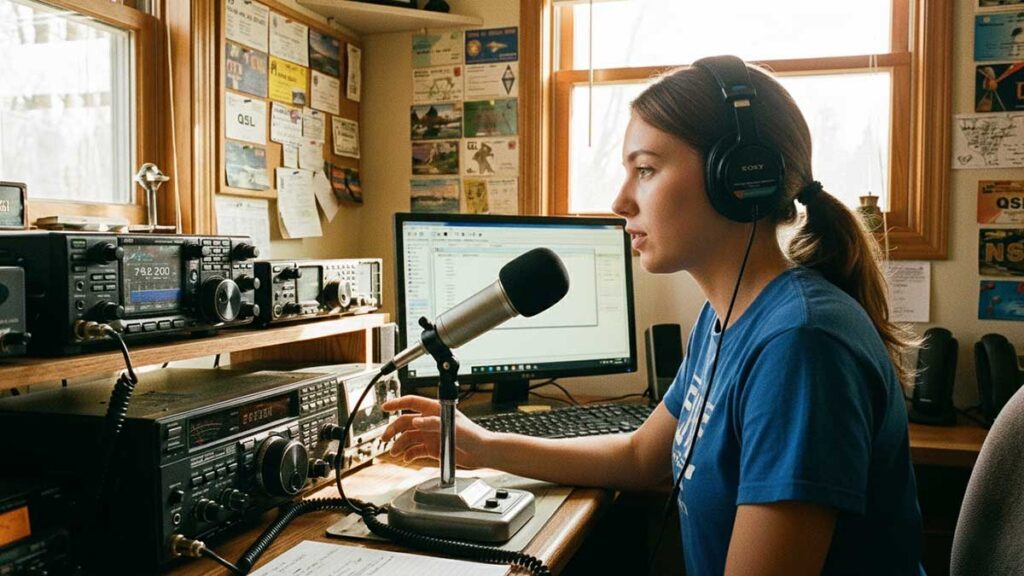
Do you remember the thrill when you passed the class 2 exam and stood in front of the radio station? Having forgotten about studying for the test, you now have to put everything into practice yourself. Your hand trembles slightly and you don’t dare press the transmit button. Horror! 😉
It may be funny to you now, but you didn’t feel like laughing at all then… Or maybe you’re taking this exact step now? Don’t worry, everything is very easy. This “stage fright” has passed through each of us. What should I do now? Won’t my voice sound stupid? Won’t the old amateurs laugh at me?
Be sure that you will cope! No one will make fun of you – on the contrary, your colleagues will be happy to hear a new person and will help you because they have been through the same path. Amateur radio is like driving – theory gives you the right, but mastery comes with the first kilometers (or the first connections).
Here’s how to get through them confidently.
Stage 1: Preparation – Before you press the PTT button
1. Get to know your equipment
Get to know your radio station’s manual as much as possible. You should feel confident that you know it.
- The antenna: Connect it carefully. Even if you have a portable one, it is advisable to use an external antenna, mounted as high as possible – on the roof or at least on the balcony. Contact local amateur radio operators – they will certainly help you with advice or installation. Make sure the SWR is within the limits (below 1.5 – 2.0) to protect your transceiver. The “rubber band” (portable antenna) is a compromise only for when you are on the move.
- Measurement: Set up the external antenna well. The SWR should be as low as possible for the desired frequencies. If you don’t have a meter (SWR meter), the community will help you – this is the “secret” of our hobby.
- On, off, lock, frequency, power, squelch (noise suppressor):Learn how to set all these things. First, research what is on the air in your area. Set a frequency. Start with low power, especially if you are on a repeater. Set the squelch so that the noise disappears, but does not “cut off” weak signals. Pay attention to whether you need to set a tone to unblock the squelch if you are setting up your radio to work through a repeater. Along with power, read about how your radio locks and unlocks – a useful feature that you may turn on unintentionally.
Step 2: Listen, Record, Learn
Step 2: Listen!
It is extremely bad manners and “lack of manners” to call a frequency without listening to it. Walk around the entire range, listen to how and what others are talking about. Learn to write down the callsigns, names and location (QTH) of the speakers. Choose a frequency, make sure it is in the allowed range for you and that you are not disturbing anyone.
Extremely important rule: Listen for 10 minutes, speak for one.
Stage 3: Conducting a radio call – practical examples
Step 3: Identify yourself and announce your intentions
The big moment has arrived. Introduce yourself clearly and distinctly. Follow what you learned on the exam – spell your initial. Don’t abbreviate it.
- On simplex (direct): “CQ, CQ, CQ! This is Lima Zulu Three Alpha India (LZ3AI). LZ3AI calls everyone and goes to receive.”
- On repeater: “LZ3AI on R1. Good evening everyone, how do I get through the repeater?”
Step 4: The Conversation and the “Round Table”
When you are answered, give your rating, name, and location. You may add details about the equipment, antenna, and time. The answer is expected to include the same information.
Working in a Group (Round Table)
If you hear a group of people, wait for a pause and say only your initial. When invited:
- Be brief.
- Follow the established speaking order.
- Always pass the microphone to the next person or to the group leader, if there is one.
Example: “…I’m passing the microphone to Ivan, LZ1XXX. This is LZ3AI and group.”
Signal Rating
The rating varies depending on the method of operation:
- Through a repeater: The Q1 to Q5 scale (quality rating) is used. Q5 is perfect quality, Q1 is barely intelligible signal.
- Simplex link (direct): The RS system is used (e.g. 59). The first number (1-5) is for intelligibility, the second (1-9) is for strength. Example: “59” (Five-nine) means a perfect link.
Step 5: International Spelling (Phonetic Alphabet)
To be understood correctly, especially in the presence of noise or interference, use the standard spelling words for the whole world. This is required when pronouncing the initial, name, QTH or other important information during the connection:
| Letter | Word | Letter | Word |
| A | Alpha | N | November |
| B | Bravo | O | Oscar |
| C | Charlie | P | Papa |
| D | Delta | Q | Quebec |
| E | Echo | R | Romeo |
| F | Foxtrot | S | Sierra |
| G | Golf | T | Tango |
| H | Hotel | U | Uniform |
| I | India | V | Victor |
| J | Juliet | W | Whiskey |
| K | Kilo | X | X-ray |
| L | Lima | Y | Yankee |
| M | Mike | Z | Zulu |
Step 5: Etiquette and Code of Conduct
- Identification:Say your initials often enough (every 5-10 minutes), but without being annoying with every line.
- Forbidden topics: In amateur radio, politics, religion, or race are not discussed, as well as any topics that could potentially cause conflict. Business is not discussed, except for buying and selling amateur radio equipment, although even in these matters, information exchange by phone or email is preferred.
- Language: In Bulgaria, we speak Bulgarian, but for international relations, English is the standard. Don’t worry about your accent and the mistakes you make – on the air, it’s the information that matters, not the grammar.
Step 6: End the conversation and write in the diary
Wish yourself the traditional 73 (best wishes). End with SK (Full end) or announce that you are quitting work (QRT).
Keep a ham-log! A log is kept during the radio call itself. No matter how soon you have heard everything, due to excitement or something else, you may not remember important things such as initials, name, QTH and after the radio call it may be too late. Write down the initials, frequency, mode, time (UTC), ratings and the name of the correspondent. The log is your story on the air. Most radio amateurs record the time in Greenwich Mean Time (GMT, UTC) to ensure uniformity worldwide. It is a matter of preference whether to record the start, end, start and end, or another time from the radio call itself.
Years ago, there was some decision not to record contacts made via a VHF (VHF or UHF) repeater. I suspect that some colleagues also do not record contacts that have developed into a “talking room” on any number of issues, but I think that at least on HF, everyone is recorded. This is somewhat a personal choice, but good practice requires that everything be recorded in the logbook. Let’s not forget that the entries in the logbook may even turn out to be important evidence in some legal proceedings or may even have historical significance.
Concluding remarks
The essence of radio amateurism is in social contacts. Join a local club – getting to know the people you talk to “in person” changes everything. Respect the traditions of the community and be respectful.
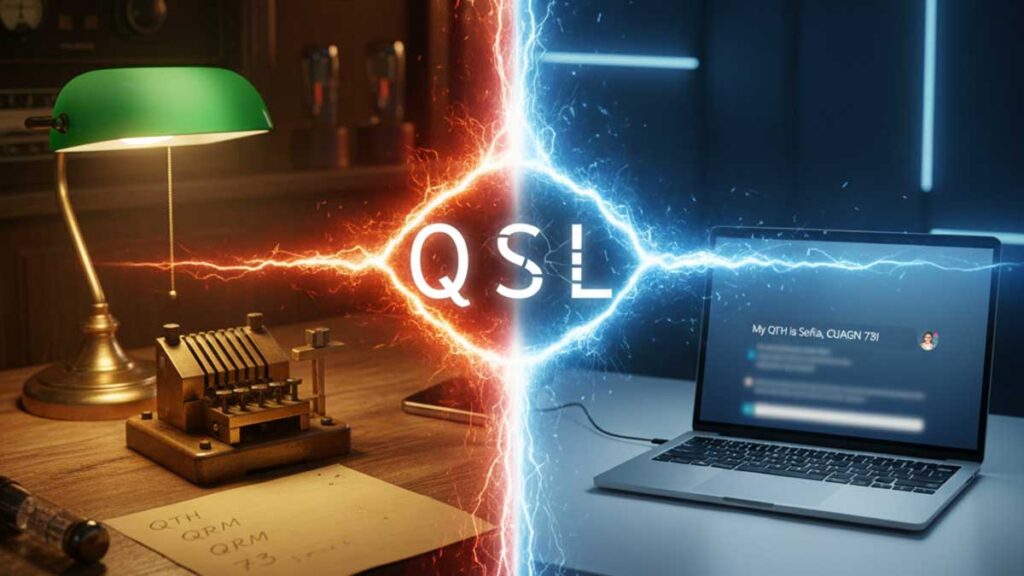
💬 TOP 10 Amateur Radio Abbreviations (Q-codes and others)
These short codes help for faster and more accurate communication.
- QTH – Location of the station (e.g. “My QTH is Sofia”).
- QSL – Confirmation of the connection or information (“QSL, I got it all”).
- QRM – Artificial interference from other stations or electrical devices.
- QSB – Signal attenuation (common in HF links).
- QRZ? – “Who’s calling me?” (used when you hear someone but don’t understand their initials).
- QRT – I’m quitting, I’m turning off the station.
- QSO – Radio contact (e.g. “Thanks for the nice QSO”).
- 73 – Best wishes (traditional ending of any contact).
- DX – Distant station (usually outside your continent).
- CQ (C-Q) – General call to all (“Calling all stations”).
📢 Question to readers:
Do you remember your first radio contact and who was your first “teacher” on the air? Share your story in the comments – it could be the inspiration a new colleague needs right now!
73 and see you on the air!