I Am a QRP Station (Low Power)

A QRP station is a station transmitting a maximum power of 5 W (CW) or 10 W (SSB).

Some operators consider QRP operation to be “aerobatics”, especially below 1 W. Don’t spoil their fun.

If you are operating at low power, do not transmit your initial as “LZ2ZZZ/QRP”, this is illegal in many countries. QRP information is not part of your call sign, so it should not be transmitted as part of it. In many countries, the only suffixes allowed are /P, /A, /M, /MM.

If you are indeed a QRP station, you will most likely be relatively quiet for the station you are calling. Adding unnecessary ballast (with /QRP) to your call sign will make your initial even more difficult to decipher.

Of course, during a QSO, you should always note that you are a QRP station, for example: “PWR 5W 5W ONLY”.

If you are calling CQ as a QRP station and want to announce this, you can do so as follows: “CQ CQ LZ2ZZZ LZ2ZZZ QRP AR”. Leave a little more space between the initial and “QRP” and do not pass a fractional dash (DAH DIT DIT DAH DIT ) between the initial and “QRP”.

If you are specifically looking for QRP only stations, call CQ as follows: “CQ QRP CQ QRP LZ2ZZZ LZ2ZZZ QRP ONLY AR”.

Using the Delimiter “=” (DAH DIT DIT DIT DAH)

Some call it “BT” because it sounds like the letters B and T rendered without a space (as “AR” is rendered without a space), but it’s the equal sign (=), also called the “delimiter ” of CW.

DAH DIT DIT DIT DAH fills the pauses for a few seconds while you think about what to convey next. It is also used as a separator (hence the name separator) between separate pieces of text.

As a filler it is used to warn the correspondent not to start transmitting because you have not yet finished your thought, or you have not finished conveying what you intend to convey. Apparently this is the equivalent of “umm…”.

Some CW broadcasters like to use “DAH DIT DIT DIT DAH ” as a separator to make the text more understandable. Example: “W1ZZZ DE G4YYY = GM = TU FER CL = NAME CHRIS QTH SOUTHAMPTON = RST 599 = HW CPY? W1ZZZ DE G4YYY KN”. The use of such separators is less common nowadays and many consider it a waste of time. “W1ZZZ DE G4YYY GM TU FER CL NAME CHRIS QTH SOUTHAMPTON RST 599 HW CPY? W1ZZZ DE G4YYY KN” is as understandable as it gets with separators.

Transmit a NICE-sounding telegraph code.

When someone listens to your CW it should be like listening to good music, no one feels like they’re deciphering an unknown code or solving a crossword puzzle.

Be sure to separate letters and words properly. Fast transmission, but with slightly longer intervals, usually makes reception easier overall.

Experienced CW operators listen for words, not letters. This, of course, can only be successful if the necessary word spacing is present. Once you start accepting words instead of a series of letters, you’re firmly established there. In normal face-to-face conversation, you also hear words, not letters, right?

On automatic key, adjust the dot/space ratio correctly. It will sound best (most pleasant) if the ratio is slightly changed – the dot a little longer than the interval – if we mean the standard 1/1 ratio.

Note: This is something different from a DIT /DAH ratio! The DIT /DAH ratio is usually fixed at 1/3 in most automatic switches (not adjustable).

How to answer CQ

Let’s assume that W1ZZZ is calling CQ and you want to QSO with him. How do you do this?

Do not transmit at a higher rate than the station you are calling.

Do not transmit the initial of the station you are calling more than once; very often the initial is not even transmitted, it is obvious who you are calling.

You can transmit “K” or “AR” at the end of the call (see above): “W1ZZZ DE LZ2ZZZ LZ2ZZZ К”, “LZ2ZZZ LZ2ZZZ К”, “W1ZZZ DE LZ2ZZZ LZ2ZZZ AR” or “LZ2ZZZ LZ2ZZZ AR”.

In many cases, only the call sign is transmitted, without any closing code (“AR” or “K”) at the end. In contests this is common practice.

Do not end your call with “..PSE AR” or “PSE K” (see above).

Someone is mistransmitting your call sign

Let’s assume that W1ZZZ did not get all the letters of your initial correctly. His response will be something like: “LZ2ZZY DE W1ZZZ TKS FOR CALL UR RST 479 479 NAME JACK JACK QTH NR BOSTON BOSTON LZ2ZZY DE W1ZZZ K”.

Now you answer him as follows: “W1ZZZ DE LZ2ZZZ ZZZ LZ2ZZZ TKS FER RPRT…”. By repeating part of your initial several times, you emphasize the wrong part of it to draw your correspondent’s attention to correct his mistake.

Calling a station that completes a QSO

Two stations are in QSO and the QSO is ending. If they both end with “CL” (I’m turning off the station), then the frequency is now free because they’ve both finished working. If one or both end up with an “SK” (end of connection), it is very likely that one of the two will stay on the frequency for more QSOs (generally the station that called the CQ on that frequency, but not necessarily – during the connection the two correspondents can understand each other differently).

In this case, it’s best to wait a bit to see if someone calls CQ again.

Example: W1ZZZ has completed a QSO WITH F1AA: “..73 CUL F1AA DE W1ZZZ SK”.

If no one calls CQ after the QSO, you can call either of them.

We assume that you (LZ2ZZZ) wish to call F1AA. How will you do it? Just pass it on

“F1AA DE LZ2ZZZ LZ2ZZZ AR”.

In this case, calling without giving the initial of the station you want to work with is unacceptable. Broadcast the initial of the station you wish to work with once, followed by your initial once or twice.

QSO on CW

We assume that W1ZZZ matches your CQ:

LZ2ZZZ DE W1ZZZ W1ZZZ AR”,

or

LZ2ZZZ DE W1ZZZ W1ZZZ K”,

or even:

W1ZZZ W1ZZZ K”,

or

W1ZZZ W1ZZZ AR”.

When answering a CQ, do not transmit the initial of the station you are calling more than once, even better not transmit it once (you must trust that the operator knows his initial…).

What should the calling station end their call with – “AR” or “K”?

Both are equally acceptable. “AR” means “End of transmission” while “K” means “Transfer to you”. The latter sounds a little more optimistic, since the station you are calling may not answer you, but another station…

However, there is good reason to use “AR” rather than “KN”. “AR” is a merged character (see above), meaning that the letters A and R are transmitted without a space between them. If, however, “K” is transmitted, and if the letter “K” is relatively close to the call sign, the letter “K” may be considered the last letter of the initial. This happens all the time. With “AR” this is absolutely impossible because “AR” is not a letter. Often none of the codes are used (neither “AR” nor “K”), which increases the risk of making mistakes.

We assume you wish to answer W1ZZZ calling you. You need to do this as follows:

“W1ZZZ DE LZ2ZZZ GE (good evening) TKS (thank you) FER (for) UR (your) CALL (call) UR RST 589 589 NAME BOB BOB QTH LEEDS LEEDS HW CPY (how did you receive?) W1ZZZ DE LZ2ZZZ K”.

This time is the time to use the “K” at the end of your delivery. “K” stands for “transfer to you” and you are W1ZZZ.

Do not end the transmission with “AR K”: it means “End of transmission, transfer to you”. It is clear that when you transfer to the other station, you are done with the transmission, there is no need to say so. End each of your transmissions during a QSO with “K” (or “KN” when necessary – see above). It is true, we often hear “AR K”, but this is not correct.

The reason for the incorrect use of “AR”, “K”, “KN”, “AR K” or “AR KN” is that many operators do not really know what each of these abbreviations mean. Let’s use them faithfully!

We clarified that it is not necessary to use the term “PSE” (please) at the end of the CQ; don’t use it at the end of your show either. So, no “PSE K” or “PSE KN”. Let’s keep things simple and drop the “PSE” please…

On the VHF bands (or above) it is normal to exchange a QTH-locator. This is a code that communicates the geographic location of your station (eg: KN12PQ).

RST report: R and S are derived from Readability (1 to 5) and Signal Strength (1 to 9) as used in telephony (see above), and T (1 to 9) in the signal report is derived from Ton. The number indicates the purity of the sound in the CW signal, which should be pure sinusoidal without distortion.

Official tone rating in RST rating

T1 60 Hz (or 50 Hz) hum, extra coarse and wide
T2 Too harsh hum, very hoarse signal
ТЗ Rectified AC hum, but not filtered
T4 Broom, some signs of filtering
Т5 Filtered AC but heavily overmodulated tone
T6 Filtered tone, obvious traces of overmodulation
T7 Near clean tone, traces of overmodulation
T8 Near perfect tone, slight traces of overmodulation
T9 Perfect tone, no trace of overmodulation

The original descriptions evaluating the various cases of T date back to the early years of ham radio, when a pure CW tone was the exception rather than the rule. The table above describes the modern CW tone ratings as published in 1995 (source: W4NRL).

In practice, we mainly use only a few levels of T, the definition of which corresponds to the general state of technology today:

Modern practical use of pitch estimation in RST estimation

T1 deeply modulated CW, elements of wild oscillations, or extremely rough AC (means: get off the air with such a bad signal!)
T5 very noticeablethe AC component (often due to a poorly regulated transmitter or amplifier power supply)
T7

T6

T7

T8

slight, barely noticeable AC component
T9 perfect pitch, undistorted sine wave

Nowadays, the most common defects of the CW signal are chirp and the even more common click or click of the switch (see below).

Chirps and clicks used to be very common problems with the CW signal: every operator knew that 579C was a report that meant a chirping signal, and 589K meant a key click. Few hams today know what the “C” and “K” at the end of the RST report mean, so you better transmit “CHIRP” or “BAD CHIRP” and “CLICKS” or “BAD CLICKS” in whole words as part of your report.

A typical way of politely ending a connection would be: “…TKS (thanks) FER QSO 73 ES (and) CUL (see you again) W1ZZZ DE LZ2ZZZ SK”. “SK” is a fused character meaning “end of connection”.

“TI TI TI TAA TI TAA” is the fused character “SK”, not “VA” as published in some places (SK delivered without a space between the two letters sounds the same as VA delivered without a space between the letters) .

Do not transmit “AR SK”. It is nonsense. You say “End of transmission” plus “End of connection”. It is quite obvious that the end of the relationship is also the end of your transmission. You may often hear “AR SK”, but “AR” is redundant, so avoid it.

If at the end of the QSO you intend to turn off your station, you should transmit: “W1ZZZ DE LZ2ZZZ SK CL” (“CL” is a fused character meaning “turn off” or “cease operation”).

An overview of the codes passed at the end:

Codes transmitted at the end of a session

CODE MEANING USE
AR end of transmission at the end of CQ and at the end of your transmission when you call a station(1)
K transfer to you at the end of the “over” (2) and at the end of your broadcast when calling any station
KN transfer to you only at the end of “over”
ARK end of transmission + transfer to you DO NOT use it
ARKN end of transmission + transfer only to you DO NOT use it
SK end of connection (the QSO) at the end of the QSO
ARSK end of transmission + end of connection DO NOT use it
SKCL end of QSO, turning off station when you switch off

(1) when responding to a station that has called CQ or QRZ.

(2) a handover or over is not the same as a QSO (link). A QSO usually consists of a series of overs.

Typical CW QSO for beginners:

QRL?

QRL?

CQ CQ G4ZZZ G4ZZZ CQ CQ G4ZZZ G4ZZZ AR

G4ZZZ DE ON6YYY ON6YYY AR

ON6YYY DE G4ZZZ GE TKS FER CALL UR RST 579 579 MY NAME BOB BOB QTH HARLOW HARLOW HW CPY? ON6YYY DE G4ZZZ K

G4ZZZ DE ON6YYY FB BOB TKS FER RPRT UR RST 599 599 NAME JOHN JOHN QTH NR GENT GENT G4ZZZ DE ON6YYY K

ON6YYY DE G4ZZZ MNI TKS FER RPRT TX 100 W ANT DIPOLE AT 12M WILL QSL VIA BURO PSE UR QSL TKS QSO 73 ES GE JOHN ON6YYY DE G4ZZZ K

G4ZZZ DE ON6YYY ALL OK BOB HERE TX 10 W ANT INV V AT 8M MY QSL OK VIA BURO 73 ES TKS QSO CUL BOB G4ZZZ DE ON6YYY SK

73 JOHN CUL DE G4ZZZ SK

Using BK

“VK” (break) is used to quickly switch between the two stations without exchanging call signs at the end of the transmission. As used in CW, it is equivalent to “over” in telephony.

Example: W1ZZZ wants to know the name of LZ2ZZZ with whom he is in contact and transmits: “..UR NAME PSE BK”. LZ2ZZZ replies immediately: “VK NAME JOHN JOHN BK”.

The break is announced with “VK” and the correspondent’s transmission also begins with “VK”. This second VC, however, is not always practiced.

Even faster

Often tothe “VK” code is not used. A momentary pause in transmission (on break standby, meaning you listen between words or letters) allows the other station to begin transmitting, just as in a normal face-to-face conversation, where each of the two takes the floor without any formality.

Using the fused character AS (DIT DAH DIT DIT DIT)

If during a QSO someone interferes (transmitting your initial at the same time as the station you are working with, or at the moment you are transferring the transmission to that station) and you want to let them know that you wish to finish the current QSO first, simply transmit “AS” , which means “wait” or “hold”.

Use of KN

“K” = “over”. By transmitting only “K” at the end of your transmission, you leave the door open for other stations to step in. If you don’t want to be interrupted, transmit “KN”.

“KN” means that you want to hear ONLY the station whose call sign you just transmitted (= “you go, others wait” or “over just for you”). In other words: no break during this time, please.

“KN” is mainly used when there is chaos around. Possible scenario: different stations respond to your CQ. You partially accept one of the initials and transmit: “ON4AB? DE LZ2ZZZ PSE UR CALL AGN (again) K”. The station ON4AB? answers, but other stations are calling you at the same time, making it impossible to receive his initial. The procedure is to call ON4AB? again and end your call with “KN” instead of “K”, thus emphasizing that you want to hear ON4AB’s answer?. Example: “ON4AB? DE LZ2ZZZ KN” or even “ONLY ON4AB? DE LZ2ZZZ KN N N” (c extra pauses between the letters N). You are really nervous now…

Call CQ on CW

What should you do first?

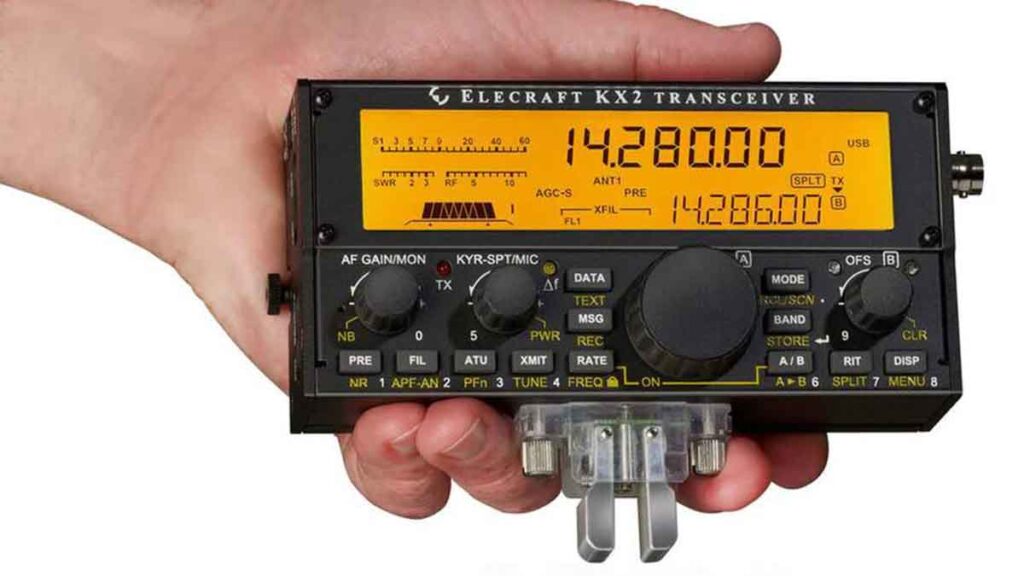
Decide which scope you will use. What range has good mileage for the road you want to cover? The monthly MIC (Maximum Usable Frequency) tables published in magazines and on many sites can help you in this regard.

Check which parts of the range are reserved for CW operation and which are allowed in your country. On most scopes they are at the bottom of the scope. Consult the IARU band plan on the IARU website and national regulatory documents.

Listen for a while on the frequency you have chosen to use to check if it is clear or not.

And after this?

If the frequency appears clear, ask if it is not in use. Pass “QRL?” at least twice in a few seconds. Pass only “?” not proper procedure. Interrogative only means “I want to ask”; the problem is you don’t want to ask about anything.

“QRL?” (with a question mark) means “Is this frequency used?”.

Do not transmit “QRL K” as we sometimes hear. This will mean “is this frequency in use? I transfer to you”. Whom? Only “QRL?” is correct.

If the frequency is in use, someone will answer “R” (Yes, understood), “Y” (Yes), or “R QSY”, or “QRL”, “C” (Confirm), etc. It is natural, logical and ethical to look for another frequency.

If a pure frequency is found?

Call CQ. How?

Send CQs at the rate you want them answered. Never transmit faster than you can receive.

“CQ CQ LZ2ZZZ LZ2ZZZ LZ2ZZZ AR”.

“AR” stands for “End of line (for now)” or “I’m done with this show,” while “K” stands for “Go on, you are.” This means that you should always end your CQ with “AR”, never with “K”, because there is no one to give the transmission to yet.

Do not end your CQ with “AR K”: it will mean “I’m done with this show, give it to you”. There is no one to transfer the show to yet. End your CQ with “AR”. It is true that we often hear “AR K” on the scope, but this is not the correct procedure!

Using “PSE” at the end of CQ (eg “CQ CQ DE … PSE K”) may seem very polite, but it is not necessary. It has no additional value. And as an addition, the use of “K” is also incorrect. Just use “AR” at the end of your CQ.

Give your initial two to four times, definitely no more.

Do not transmit an endless series of CQs, but only your initial once at the end. If you think that a longer CQ increases your chances of getting a response, you are wrong. In reality, the effect is just the opposite. The station that might be interested in calling you wants to know your call sign first and certainly isn’t interested in listening to your endless string of CQ CQ CQ…

It is much better to transmit a few short CQs “CQ CQ de F9ZZZ F9ZZZ AR”) than a long carousel CQ CQ CQ CQ … -15 times-de F9ZZZ CQ CQ CQ … -15 more times- de F9ZZZ AR”).

If you are calling CQ and want to operate on spread frequencies (receive on a different frequency than you are transmitting on), mention your receive frequency on every QSO. Example: end your CQ with “UR 5/10…” or “UR 5…” or “QSX 1822…” (which means you’re listening on 1.822 kHz; “QSX” means “listening on. ..”).

Merged characters

Amalgamated characters (also called short or professional characters) are characters formed by combining two characters into one without a space between them.

“AR” used at the end of the transmission is a merged character.

Other commonly used fusion characters are:

  • “AS”
  • “CL”
  • “SK”
  • “HH”

“VK” (see below) and “KN” (see below) are not fused characters, as the two letters of these abbreviations are transmitted with a space between them.

Call CQ DX

Just transmit “CQ DX” instead of “CQ”. If you want to work DX from a specific area, call for example “CQ JA CQ JA I1ZZZ I1ZZZ JA AR” (call for stations from Japan), or “CQ NA CQ NA…” (call for stations from North America), etc. n. You can also make a CQ DX call excluding an area, for example if you don’t want to work with European stations: “CQ DX CQ DX I1ZZZ I1ZZZ DX NO EU AR”, but that will sound a bit aggressive.

You can also name a specific continent: NA = North America, SA=South America, AF=Africa, AS=Asia, EU=Europe, OC=Oceania.

Even if a station from your continent calls you, always be polite. Maybe he’s a beginner. Give him a quick report and log it. In fact, you may be a new country to him!

Call a specific station (direct call)

Let’s say you want to call DL0ZZZ with whom you have a sked. Here’s how you do it: “DLOZZZ DLOZZZ SKED DE LZ2ZZZ KN. Note the KN at the end, which means you only want the other station to call you.

If, regardless of the specific call, nowhoever else called you, give him a short report and hand him “SRI HVE SKED WID DL0ZZZ 73…”.

The Art of the CW

The Art of CW – Telegraphy, Morse Code, Morse Alphabet

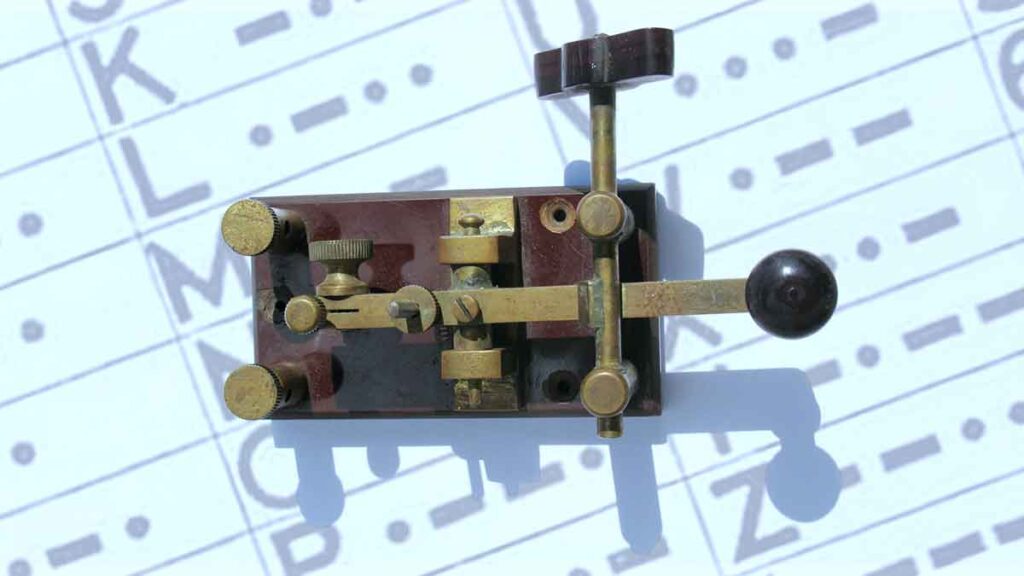
Morse code (Morse alphabet) is a code for transmitting text. The code is formed by a series of short and long audio tones. We pronounce the short tone as DIT, the long tone as DAH. Each TAA is three times longer than each DIT. Often they are called DOTS and DASHES, which is debatable whether it is the most appropriate because it makes us think visually instead of tonally.

Morse code is not a series of written DOTS and DASHES, although originally in the 19th century, Morse code was written as a series of DOTS and DASHES on a moving tape. Telegraph operators soon found that it was easier to pick up the characters by the noise of the tape recorder than to read what was written on the tape. So, the letter “P” is not a “SHORT LONG SHORT” signal, nor “DIT DAH DIT”, nor “.-.”, but “DI-DAH-DI”.

In some languages the letter “P” should be written as DIT-TAA-DIT, in others as DI-TAA-DI. But it should be clear that there are only two sounds – short (DI or DIT) and long (DAH). Some radio amateurs prefer the dot at the beginning or through the sign to be denoted by DI, and when it is at the end – “DIT”, which expresses the completion of the sound signal. To avoid confusion, from now on in this edition only DIT and DAH will be used.

CW implies heavy use of Q-codes, abbreviations and fusion characters. All of them are the shortest way to fast and efficient communications.

Hobbyists normally use the word CW for telegraphy.

The origin of CW is from a continuous wave (Continues Wave), although CW is not a continuous wave at all, but can be taken as a wave continuously interrupted in the rhythm of Morse code. Hams use Morse and CW interchangeably – they mean the same thing.

The bandwidth at the -6 dB level of a properly shaped CW signal is approximately equal to 4 times the transmission rate in words per minute (WPM). Example: CW at 25 WPM occupies a 100 Hz band (at -6 dB level). The spectrum needed to transmit an SSB (voice) signal (which is 2.7 kHz) can accommodate dozens of CW signals.

CW’s inherent narrow bandwidth results in a much better signal-to-noise ratio under difficult conditions than wider-band signals such as SSB (a wide-band signal contains more noise than a narrow-band signal). Also, the human ear (especially of an experienced radio amateur) is still the best sensor in poor signal-to-noise conditions. That is why DX connections in difficult conditions (eg with a station from another continent on 160 m or EME) are made much more often on CW.

What is the minimum receive speed you need to master to be able to make regular morse code QSOs?

  • 5 WPM (25 bpm) might get you a starter certificate, but you won’t be able to make many connections with them except on the dedicated QRS (QRS stands for: slow down) frequencies. These QRS rates can be found on the IARU band-plan.
  • 12 WPM (60 zpm) is the minimum, but most experienced CW operators make their QSOs at 20 to 30 WPM (100-150 zpm) and even higher speeds.

There is no secret recipe for perfecting the art of CW: practice, practice, practice, just like in any other sport.

CW is a unique language, a language that is studied in all countries of the world!

Correct use of QRZ

“QRZ” stands for “Who’s Calling Me?”, no more, no less.

The classic use of “QRZ” is after CQ when you have failed to receive the initial(s) of the station(s) calling you.

It doesn’t mean “Who’s here?”, nor does it mean “Who’s on the frequency?”, much less “Call me please”.

If someone settles on an apparently clean frequency and wants to check that it is not in use, they should do so with “QRZ?”! Just asking if the frequency is in use. If you have been listening to a station that has not been identified for a certain amount of time and want to know its call sign, you should ask “Your initial, please” or “Please identify yourself”. Strictly speaking, you should also add your initial to these lines, as it is also necessary to identify yourself.

“QRZ” certainly doesn’t mean “Call me please”. More and more we hear CQ calls ending with the word “QRZ”. This is nonsense. How can someone call you when you are the one calling with the CQ? He can only answer…

Another incorrect use of “QRZ”: Calling CQ in a contest. A station tunes in to your frequency and picks up on the end of your CQ, but misses your call sign. We often hear stations in such circumstances saying “QRZ”. Totally wrong. No one has called this station. What the station has to do is wait for your next CQ to find out your initial! The same remark applies to the CW, of course.

Another similar and quite funny but incorrect expression is: “QRZ, is this frequency used?” (should be “Is this frequency in use?”).

During a pailup (see below) we often hear a DX station say “QRZ”, but not because it missed an initial, but to let the pailup know that it is listening again. Such use of “QRZ” is not very correct.

Example:

CQ ZK1DX (ZK1DX calls CQ).

ON4YYY 59 for you (ON4YYY called ZK1DX, he answers and gives him a report).

QSL QRZ ZK1DX (ZK1DX confirms report received from ON4YYY). “QSL” and adds “QRZ”, which in this case means listen again for the stations that called me, not who’s calling me?, which is the real meaning of “QRZ”.).

Although it is arguable whether he has heard other stations before and hence his “QRZ”, using “QRZ” followed by “ZK1DX” is by no means the most efficient procedure.

Sometimes we even hear what is totally wrong:

QSL QRZ (in this case ZK1DX is not identified at all. The pile wants to know which DX station it is.).

The correct and much more effective procedure is:

QSL ZK1DX (ZK1DX confirms that he has received the report, saying “QSL”. This is followed by his initial, which is a sign for the paylap to call him.).

On CW, always transmit QRZ followed by a question mark “QRZ?” as should be done with all Q-codes when used as a question. The question can completely change the meaning of the code.

Typical usage: after CQ F9ZZZ is unable to accept the initial of any of its callers. Then he broadcasts, “QRZ? F9ZZZ”.

If you managed to receive part of the initial (ON4…) and other stations are also calling you, do not transmit “QRZ”, but “ON4 AGN (again) K” or “ON4 AGN KN”. Here “KN” clearly indicates that your question is addressed to ON4 station. Note that in this case “K” or “KN” is used, but not “AR”, because you are not addressing a specific station, but a station in general – an ON4 station whose suffix is missing. Do not transmit “QRZ” in this case because all stations will start calling you again.

“QRZ” doesn’t mean “Who’s here?” or “Who’s on the frequency?”. Imagine someone comes onto a busy frequency and starts listening. After some time, during which no one identifies himself, he decides to establish the initials. The correct way to do this is by passing “CALL?” or “UR CALL?” (or “CL?”, “UR CL?”). Using “QRZ” here is incorrect. Remember that when asking “CALL?” you should generally transmit your initial, otherwise you are making a transmission without identification, which is illegal.

If you get this code frequently:

  • Check your transmission quality.
  • Have you set up your transmitter correctly?
  • Have you set the microphone gain too high?
  • Is the speech processor level too high? The ambient noise level should be at least 25 dB below the peaks of your voice. This means that when you are not talking, the output level of the transmitter should be approximately 300 times lower than the peaks when you are talking.
  • Ask a radio amateur neighbor to check your broadcast for unwanted side emissions.
  • The best system for constant monitoring is to have an oscilloscope, with which to monitor the output signal.

Calling a Specific Station

Let’s say you want to call DL1ZZZ with whom you have a sked (sked – pre-scheduled connection). Here’s how you should do it:

“DL1ZZZ, DL1ZZZ here is LZ2ZZZ calling you for a sked and listening”.

Or in short:

“DL1ZZZ, DL1ZZZ here LZ2ZZZ, for sked and listen”

If, despite your specific call, someone else calls you, remain polite. Give him a quick assessment of the signal and say:

“Sorry, but I have a sked with DL1ZZZ”.

What does CQ DX mean?

If you want contact with a station located far away, call “CQ DX”.

What is DX?

On KB: a station outside your continent or from a “country” (amateur) with very limited amateur activity (eg Mount Athos or the Order of Malta in Europe).

Note: The term “amateur country” refers to a geographical area with a separate amateur prefix. Administratively, this prefix may be under the administration of another country or geographically located in a foreign country, and for the purposes of competitions and diplomas it is considered a separate country. For example:

    • The UN has its own prefix, even though it is located in the US.
    • Aruba is a Dutch territory, but geographically it is on a completely different continent and with a different prefix.

On VHF-Microwave: station located approximately more than 300 km away. In reality, it may even be in the same country.

During CQ, you can emphasize that you only want to work with DX stations like this: “CQ DX outside of Europe, here it is…”.

Always be kind; maybe the nearby station calling you after your CQ DX is a newbie radio amateur, maybe you’re a new country to him. Why not just do a quick QSO with him?

With DX connections, a short quick exchange is tolerated, often including only initials and rating to take advantage of the good traffic from the maximum number of hams.

Content of QSO conversations

No matter the mode of communication, our conversations must be related to the radio amateur hobby. Ham radio is a hobby related to the technique of radio communications in the broad sense of these words. We shouldn’t be using ham radio to broadcast a shopping list for dinner…

Some of the topics that should never be allowed in ham talk on the air are:

  • religion;
  • policy;
  • business (you can talk about your profession, but not advertise your business);
  • derogatory remarks addressed to some group (ethnicity, religion, race, gender, club, professional group, etc.);
  • indecent humor: if you wouldn’t tell a joke to your ten-year-old, don’t tell it on the radio;
  • any topic that has nothing to do with the ham radio hobby.

It is acceptable, when a jubilee or other special initial is used, to elaborate on the story that gave rise to that special initial.